Some of the most influential objections to Raagmala begin with very small features: a missing authorial heading, the absence of the name Nanak, an unfamiliar musical term, or the position of a composition after Mundavani. Each observation seems easy to make. The harder question is whether it can support the conclusion placed upon it.
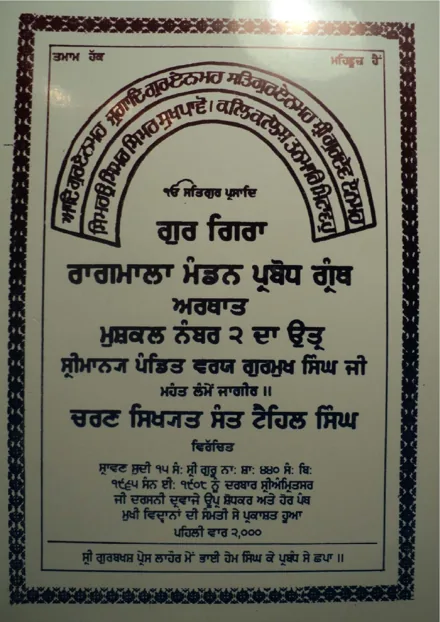
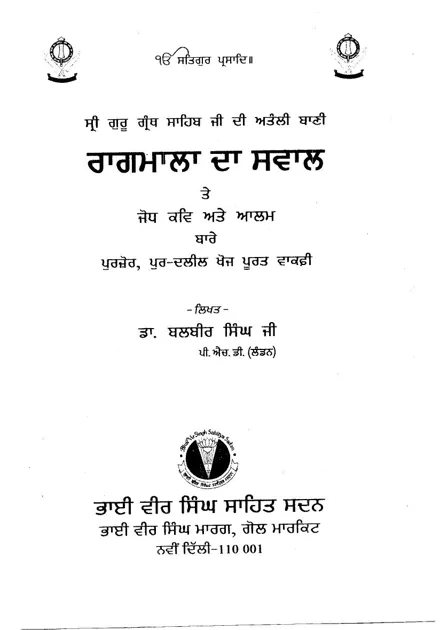
Sant Tehal Singh and Dr Balbir Singh repeatedly return to this problem in their defences of Raagmala. They ask whether the proposed tests of authenticity are sound, and whether those tests are applied consistently. Tehal Singh works through examples inside the scriptural text. Balbir Singh examines the language and transmission of the works brought into comparison with it.
Their approaches meet in an important principle: an objection needs a reliable rule behind it. A feature cannot disqualify Raagmala merely because it is noticeable or unusual. The rule must also make sense of the texts the reader already accepts.
What an absent signature can establish
Tehal Singh begins his detailed rebuttal with objections concerning attribution. Raagmala does not carry a numbered Mahalla heading identifying a Guru, nor does it end with the name Nanak or the name of a Bhagat. For its opponents, these absences count against its status as Gurbani.
His reply is to test the proposed requirement against Japji Sahib. Japji does not begin with the kind of numbered Mahalla heading being demanded of Raagmala. Within Japji, individual pauris also occur without the name Nanak. The sixth pauri, beginning Tirath nava je tis bhava, is one of his examples.1
This comparison has a specific logical force. If every accepted passage had to carry the same form of attribution, these familiar exceptions would become a problem too. The absence of that form therefore cannot function as an automatic test of exclusion.
There is an important distinction between a composition being anonymous to a reader and a composition being unauthorised. A reader may be unable to identify authorship from a heading alone. That does not establish that the text entered the scripture without authority. Such a conclusion requires further evidence concerning its history and transmission.
Tehal Singh’s argument becomes stronger because he also tests the opposite proposition. He points to compositions outside the accepted scriptural corpus that carry a Mahalla-style heading or use the name Nanak. Such features do not, by themselves, secure acceptance.2
Taken together, the two comparisons remove the possibility of a simple visual test. The marker is not universally required in the form proposed, and its presence is not enough on its own. Attribution has to be considered with context, received authority and manuscript evidence.
Tehal Singh is not asking readers to disregard headings. He is challenging the claim that one kind of heading can bear the entire weight of a decision about scriptural status.
Balbir Singh’s parallel caution about a single word
Balbir Singh applies a related discipline while examining the poem attributed to Alam. In that setting, the occurrence of the word gurmukh might seem a convenient clue connecting the poet with the Sikh world. Yet Balbir Singh explicitly cautions that the word alone is not final proof of Alam’s association with Guru Gobind Singh Ji’s court.3
The two authors are discussing different texts, and their arguments should not be presented as identical. Tehal Singh challenges an exclusion based on a missing marker. Balbir Singh limits an attribution based on a present marker. The comparison is valuable precisely because the underlying discipline works in both directions.
A word or heading can contribute to an argument. It becomes stronger when it agrees with other evidence: chronology, textual relationships, manuscript features and historical context. Detached from those things, it is easily asked to prove more than it can.
This is one of the most useful connections between the books. Both resist shortcuts in which a small textual feature is promoted into a complete explanation of a work’s origins.
Mundavani and the question of what follows
The objection concerning Mundavani makes a different kind of claim. If Mundavani is understood as the closing seal of Sri Guru Granth Sahib Ji, how can a composition placed after it belong to the scripture?
Tehal Singh responds by examining the sequence itself. Following Mundavani is the salok of Guru Arjan Dev Ji beginning Tera kita jato nahi. The presence of this accepted salok means that a rule excluding everything after Mundavani would immediately have consequences beyond Raagmala.4
He also presses for clarity about what is being called the seal. Is it the heading, the hymn under that heading, or a broader act of closure? Each interpretation needs to account for the material that follows. The word alone cannot substitute for a reading of the actual arrangement.
Tehal Singh further points to the use of mundavani in a passage associated with Guru Amar Das Ji in Sorath ki Var, where it occurs with the image of a platter containing spiritual nourishment. That comparison challenges an exclusively mechanical reading of the term as a prohibition against any succeeding text. Meaning has to be drawn from the passage and its setting.
His own defence goes further: he presents Raagmala as the final seal. Readers should recognise this as part of his positive interpretation of the scriptural ending. The narrower result of his rebuttal is already significant, however. Simply saying that Raagmala follows Mundavani does not settle the question of its authority. The adjoining salok and the meaning of the term must be addressed.
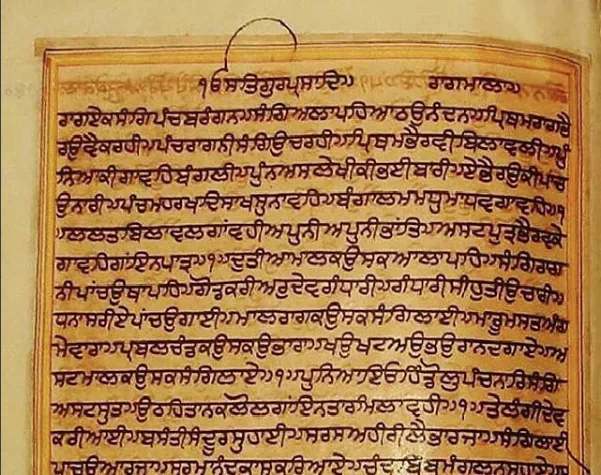
Balbir Singh’s contribution here is broader rather than a duplicate of Tehal Singh’s word-by-word argument. His defence repeatedly directs attention to the integrity and material history of the Bir. The ending of a manuscript has to be studied through the manuscript itself: its sequence, index entries and writing. That gives historical substance to Tehal Singh’s insistence that a theory of closure must fit the actual text.5
The combined approach therefore moves through two stages. First, test the interpretation of the ending. Then examine how the ending is transmitted. A semantic argument about a title and a historical argument about a manuscript can inform one another, but neither should be silently substituted for the other.
Does every passage need to sound like a hymn?
Tehal Singh also considers the objection that Raagmala lacks explicit spiritual instruction. Its musical names and family relationships may appear too technical to qualify as Gurbani.
His answer again begins with comparison. Sri Guru Granth Sahib Ji includes raag headings, ghar indications and directions concerning tunes. These elements have a recognised function even though they are not all devotional statements in the same sense as the hymns they accompany.6
The point is about the range of functions within the text. A scriptural composition can include organisation, musical direction and other forms of information alongside direct instruction. It is therefore inadequate to judge every component by the expectation that it must contain the same vocabulary or communicate its significance in the same way.
This argument clears away a proposed reason for rejection. It still leaves the positive historical question: what evidence connects this particular composition with the received scripture? Tehal Singh answers that elsewhere through his manuscript inventory. Balbir Singh develops the manuscript question in greater detail.
Their books consequently offer a layered defence. Literary difference is addressed through interpretation; historical belonging is addressed through testimony and the Birs. Keeping those layers distinct makes the reasoning easier to follow.
When a different spelling becomes an accusation
Balbir Singh’s examination of musical names adds another dimension. Critics had treated differences between Raagmala and the poem attributed to Alam as evidence that an unskilled copier had introduced errors into the scriptural text. This argument assumes that the wording in the comparison text is both stable and correct.
Balbir Singh checks that assumption. The Alam manuscripts he compares do not all give the same readings. For the name appearing as Champak in Raagmala, he records several differing forms in copies of the Alam text, including Panchak and related variants. He then notes that another musical list invoked in the debate uses the form found in scripture.7
The significance lies in the comparison. If the proposed standard varies across its own witnesses, it cannot simply be placed above the scriptural text as an unquestionable original. The reader must establish which reading is being used, where it comes from, and why it should be preferred.
Balbir Singh also challenges the idea that linguistic difference is always corruption. His discussion of Suhu, Suho and the proposed Suhavi reading turns on historical forms, pronunciation and spelling. A word can change across language, period or writing practice without becoming meaningless. He argues that the spelling habits of Gurbani should be considered on their own terms.8
This does not make every variant equally convincing. It changes the work required to call one a mistake. A judgment should emerge from comparison and usage rather than from the assumption that the form familiar to the critic must be the original.
Here Balbir Singh strengthens Tehal Singh’s method in a particularly concrete way. Tehal Singh tests whether a proposed rule would unjustifiably exclude accepted scriptural passages. Balbir Singh tests whether a proposed linguistic standard has itself been established. Both ask the reader to examine the measuring instrument before accepting its verdict.
A more demanding standard of judgment
Read together, the books replace several quick tests with fuller questions.
| Proposed test | What the comparison asks instead |
|---|---|
| No Mahalla heading or Nanak signature | Is that marker universally required, and can it establish authenticity by itself? |
| Placement after Mundavani | Does the interpretation account for the accepted salok and the transmitted ending? |
| Technical musical subject matter | How does the text already accommodate headings, classifications and musical directions? |
| A form differs from an Alam version | Which version is being used, how stable is it, and what explains the variation? |
| One word suggests a historical connection | Is that clue supported by chronology and other independent evidence? |
This is where the two defences gain force from being read together. They do more than supply several answers to several objections. They expose a recurring weakness in the way the objections can be framed: a disputed assumption is treated as though it were a settled rule.
Removing those assumptions does not, by itself, identify the author of Raagmala or reconstruct every stage of its transmission. The positive case still depends on the manuscript and literary evidence examined in the two books. But the ground on which that evidence is considered has changed. Raagmala can no longer be excluded merely because it lacks one familiar marker, has a distinctive literary form, or contains a name that differs from an unstable comparison text.
The question becomes more exacting and more productive: what explanation best accounts for the wording, the setting and the documented place of this composition in the Birs? That is the question both authors want the reader to pursue.
Source notes: Only the two supplied books are used. References give printed pages followed by PDF pages. The comparisons and limits identified between the authors are the analysis of this article; they are not presented as joint statements written by the authors.
Source notes
-
Sant Tehal Singh, Gur Gira Raagmala Mandan Prabodh Granth, pp. 15-16 (PDF pp. 16-17). ↩
-
Tehal Singh, pp. 17-18 (PDF pp. 18-19), including his reverse test involving compositions with attribution markers. ↩
-
Dr Balbir Singh, Ragmala Da Swal, pp. 30-33 (PDF pp. 36-39), especially his explicit qualification on p. 33. ↩
-
Tehal Singh, pp. 18-19 (PDF pp. 19-20), on Mundavani, the following salok and the comparison with Sorath ki Var. ↩
-
Balbir Singh, pp. 57-69 and 176-180 (PDF pp. 63-75 and 182-186), on the Kartarpur Bir, its index and the inspection reports. ↩
-
Tehal Singh, pp. 23-24 (PDF pp. 24-25). ↩
-
Balbir Singh, pp. 181-188 (PDF pp. 187-194), particularly the comparison of Champak and variant forms on pp. 185-186. ↩
-
Balbir Singh, pp. 193-197 (PDF pp. 199-203), on manuscript readings, linguistic change and the Suhu/Suho comparison. ↩