The opening pages of Sant Tehal Singh’s defence of Raagmala contain something more personal than a list of arguments. They preserve declarations of approval, names of supporters, statements associated with religious centres, and letters from readers who wanted the work published. The pages convey a community responding to a dispute about the scripture it revered.
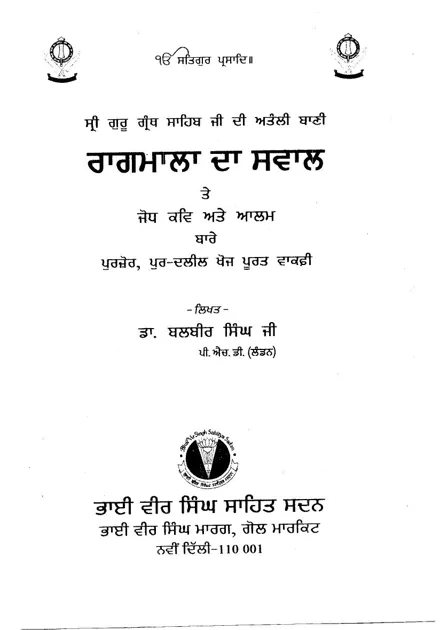
Dr Balbir Singh’s later Ragmala Da Swal also treats the dispute as a matter of collective importance. Alongside literary comparison, it discusses public controversy, the preservation of the Bir and efforts to inspect the manuscript at the centre of the argument.
Both authors believe Raagmala belongs within Sri Guru Granth Sahib Ji. What makes their books valuable together is the variety of ways in which they defend that belief. Community testimony, textual reasoning and manuscript examination each contribute something different. Understanding those contributions produces a stronger cumulative case than treating every endorsement as though it proved every historical claim.
What Tehal Singh’s endorsements show
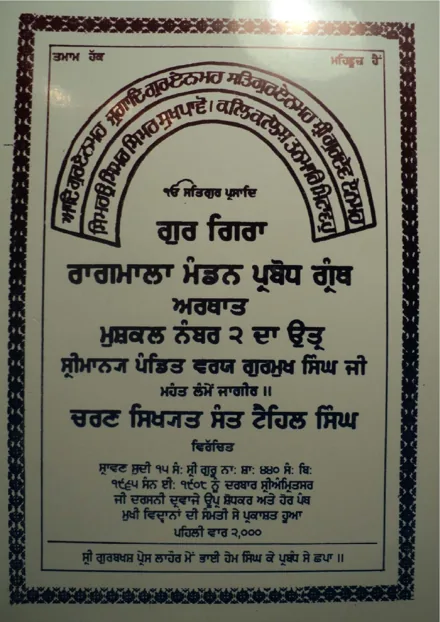
Tehal Singh’s Gur Gira Raagmala Mandan Prabodh Granth, bearing the date 1908 on its cover, responds to objections presented under the second problem in Khalsa Rahit Prakash. In his prefatory appeal, he asks knowledgeable readers to consider the work and send their judgments. His concern includes the divisions that the controversy has created within the Panth.1
The following pages record a substantial network of approval. They include statements associated with Kesgarh Sahib, Damdama Sahib, Muktsar, Bhaini Sahib and the Bhai Rupa lineage, along with many named individuals. Some statements describe hearing or considering the work; others affirm the status and recitation of Raagmala or encourage publication.2
This material is evidence of support across several settings. It shows that Tehal Singh’s defence was shared, discussed and welcomed beyond the author’s immediate circle. It also reveals the social purpose of the book: to answer objections in a form that could circulate among readers and congregations.
The numbering continues beyond 121 to entries numbered through 131. Even so, a numerical total should not be turned into a claim that every person performed the same investigation or signed an identical scholarly finding. The pages contain several forms of assent, with different scopes.
The distinction is visible even in the presentation of institutional authority. The Kesgarh statement explains why a seal was not affixed: those concerned were dispersed and difficult to assemble. Other declarations reproduce seals. Describing the entire collection as a single formally sealed verdict would flatten details that the source itself preserves.
The most accurate description is substantial documented support for the defence. A universal settlement of the debate would require a different kind of evidence, and the existence of the controversy throughout both books makes that stronger claim especially difficult to sustain.
Read each testimonial for what it actually says
Two endorsements show why close reading matters.
The first is associated with Dr Charan Singh. Before presenting it, Tehal Singh explains that the original letter has been misplaced and that Charan Singh has died. He therefore reproduces portions from memory and names people connected with the occasion. The passage should be read as Tehal Singh’s remembered account of the endorsement, rather than as a complete surviving letter.3
Within that account, Charan Singh is said to have checked references against books in his possession while reading the defence. This is a meaningful form of scholarly engagement. It is not a claim that he owned and authenticated a collection of ancient Birs. The difference matters because it determines which part of Tehal Singh’s case the testimonial supports.
The same remembered endorsement contains another revealing detail: Tehal Singh reportedly softened passages at Charan Singh’s suggestion. The concern was not simply whether the author reached the preferred conclusion. It included how the argument was expressed to fellow Sikhs.
The second example is Giani Shardul Singh’s statement dated 25 December 1908. He explicitly says that limited time prevented him from reading the entire book. He had heard objections and responses, found the replies appropriate, and supported publication.4
That is a positive endorsement, but it is also a qualified one. Preserving the qualification respects the witness’s own words. Expanding it into a claim of complete textual verification would weaken the accuracy of the account.
Jawahar Singh Kapur’s designation as a Fellow of Punjab University needs similar care. It identifies the standing of the individual endorsing the work; it does not, by itself, transform his letter into an official university judgment.5
These details make the endorsement pages more interesting. They show different readers participating in different ways: examining references, listening to arguments, encouraging publication and asking for a more measured tone. The historical record gains depth when those roles remain visible.
Balbir Singh distinguishes preservation from adjudication
Balbir Singh’s opening address provides a useful counterpart to the endorsements. He presents the integrity of the Bir as an issue affecting the community as a whole. Yet a document he quotes also shows why defending preservation and settling authorship must be distinguished.
The Patiala order dated 20 May 1918, as reproduced in his book, responds to the printing of volumes without Raagmala. It directs remedial action while expressly declining to enter the question of whether Raagmala is Gurbani.6
That wording is important. The order supports preservation of the received volume without presenting itself as a final determination of the theological dispute. Its practical direction and its stated scope must be read together.
This helps clarify the different kinds of authority present in the two books. A supportive letter shows what its writer accepted. A collective declaration records the position of those represented. An order may govern a particular action. A manuscript report describes an examination. Each can be important without doing the work of all the others.
The comparison also guards against a misleading account of historical unanimity. Tehal Singh gathers support in a period of controversy; Balbir Singh’s later work shows the debate continuing. Their agreement is real, but it is the agreement of two defenders and the witnesses they present, rather than evidence that every Sikh authority had reached the same conclusion.
Examination gives testimony a more specific object
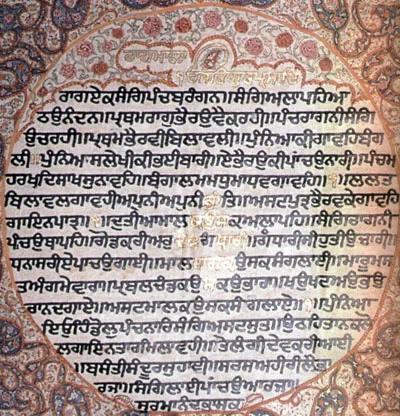
Balbir Singh’s reproduction of the 1945 Kartarpur inspection reports adds a different kind of support. The reports do not simply state that their signatories favour Raagmala. They identify features of the manuscript: its writing, pagination, index entry and the location of the composition.7
Tehal Singh had already reported similar features in his description of Kartarpur and in his wider inventory of Birs. The later reports therefore strengthen a particular part of the earlier defence. They return to the physical questions on which the claim of continuity depends.
The distinction between endorsement and examination helps explain why this is valuable. Agreement with an author’s conclusion does not necessarily add a new observation. A further inspection can do so, especially when it addresses a disputed point in enough detail for the reader to understand what was checked.
Even here, the relationship between reports matters. Balbir Singh’s December statement explicitly describes checking some of the notes taken during the September visit. The later testimony is connected with the earlier investigation. Its contribution is confirmation of the points examined, not an entirely separate discovery of every fact.
The strongest use of these books therefore asks two questions together: what do the witnesses agree about, and how did each reach or support that judgment?
A defence can become stronger by correcting itself
Balbir Singh’s treatment of readers’ corrections provides another useful comparison with Tehal Singh’s invitation to scrutiny.
In one chapter, Balbir Singh acknowledges a correction concerning the publication date of Gurmat Sudhakar: 1899 rather than 1901. He explains the source of his earlier statement and adjusts the point under discussion.8
In another, he revises his description of the metre in Jodh’s Sanskrit work. His initial impression had been formed through a Gurmukhi presentation of the verses. After reading the manuscript in Devanagari, he accepts that the verses are in Anushtubh metre.9
The second example is particularly instructive. A conclusion about the form of a work changes when the author consults a more suitable witness. The correction concerns a detail within the broader defence; acknowledging it does not require abandoning every other argument.
These moments should not be used to portray either book as free from polemic. Both contain sharp language, and some historical or devotional claims are asserted more confidently than the evidence presented would allow a modern reader to verify. But the books also preserve practices worth retaining: inviting judgment, checking references, revisiting a manuscript and correcting a mistake.
The remembered account of Charan Singh asking for gentler wording and Balbir Singh’s acceptance of a textual correction illuminate different aspects of responsible argument. One concerns how a case is addressed to the community; the other concerns how it responds to evidence.
Where the cumulative case becomes strongest
The two books reinforce one another most effectively when their contributions are connected to the specific questions they answer.
| Question | Tehal Singh’s contribution | Balbir Singh’s contribution | The resulting reinforcement |
|---|---|---|---|
| Must musical arrangements match? | Discussion of differing classifications and scriptural headings | Explanation of different kinds of order and close analysis of names | A difference in arrangement needs interpretation before it becomes an objection |
| Are the tests of authenticity reliable? | Counterexamples to rules based on signatures, headings and subject matter | Scrutiny of linguistic standards and comparison texts | The proposed test must be established and consistently applied |
| Does resemblance to Alam prove borrowing into scripture? | Challenges to the proposed original and its dating | Analysis of adaptation, chronology, variants and narrative setting | Resemblance alone leaves the direction of borrowing unresolved |
| Was Raagmala added later to the Bir? | Descriptions of Kartarpur and other named manuscripts | Detailed inspection reports and a personal examination | The addition theory must address the reported writing, index and pagination |
| How was the defence received and developed? | Endorsements, requests for judgment and reported revision | Public controversy, repeated examination and acknowledged corrections | Support becomes more informative when its basis and scope are clear |
The gain is cumulative because these lines of argument address different weaknesses in the case against Raagmala. The musical discussion answers an expectation about order. The textual discussion tests proposed criteria. The Alam comparison examines the alleged source. The manuscript reports address the composition’s place in a physical witness.
No single endorsement needs to carry all of that weight. Nor must every supporting historical detail be equally strong for the comparison to have value. The important task is to connect the evidence to the conclusion it can actually support.
That produces a clear shared defence: Raagmala should not be rejected through inconsistent textual tests, an assumed direction of literary borrowing, or descriptions of manuscripts that fail to account for their reported features. Tehal Singh establishes several of these challenges; Balbir Singh deepens them through extended comparison and examination.
Their agreement is most persuasive where it remains open to inspection. Names, pages, readings, dates and manuscript features give the reader something to follow. The enduring strength of the two books lies in that movement from conviction towards a case whose parts can be examined together.
Source notes: Only the two supplied books are used. Historical orders and endorsements are discussed as reproduced in those books; no claim is made here about present-day liturgical regulations. References use printed pages followed by PDF pages.
Source notes
-
Sant Tehal Singh, Gur Gira Raagmala Mandan Prabodh Granth, cover and p. 1 (PDF pp. 1-2). ↩
-
Tehal Singh, pp. 2-8 (PDF pp. 3-9), including the Kesgarh statement and the continuation of numbered entries through 131. ↩
-
Tehal Singh, pp. 7-8 (PDF pp. 8-9), including the explanation that the original letter is missing and the account is reconstructed from memory. ↩
-
Tehal Singh, pp. 8-9 (PDF pp. 9-10), letter dated 20 October 1908. ↩
-
Dr Balbir Singh, Ragmala Da Swal, pp. 18-19 (PDF pp. 24-25). ↩
-
Tehal Singh, pp. 43-50 (PDF pp. 44-51); Balbir Singh, pp. 59-69 and 176-180 (PDF pp. 65-75 and 182-186). ↩
-
Balbir Singh, pp. 107-108 (PDF pp. 113-114). ↩
-
Balbir Singh, pp. 114-115 (PDF pp. 120-121). For the musical, literary and linguistic comparisons in the final table, see Tehal Singh, pp. 15-30 (PDF pp. 16-31), and Balbir Singh, pp. 9-15, 24-56, 123-178 and 181-204 (PDF pp. 15-21, 30-62, 129-184 and 187-210). ↩