A date written inside a book seems to offer a firm starting point. Yet if the book is a translation, the date may belong to the work being translated. If the translator has added material from elsewhere, different parts of the same volume may also have different histories.
That problem stands near the centre of Dr Balbir Singh's Ragmala Da Swal. His investigation follows the relationship between Raagmala and the romance Madhavanal Kamakandala, especially the version associated with Alam. The shared material had been used to argue that Raagmala was borrowed into Sri Guru Granth Sahib Ji from a secular poem. Dr Balbir Singh argues for borrowing in the other direction.
To make his case, he moves through Sanskrit and vernacular versions of the story, compares literary passages, examines how dates are being used and considers Alam's association with Guru Gobind Singh Ji's court. The enquiry becomes a study of how a text is made from older and newer material, and how that history can be reconstructed.
First, identify the people and the books
The investigation becomes much easier when its names are kept separate.
Madhavanal, also called Madhav, is the male protagonist of the romance. Kamakandala is its principal female character. Their names provide the title of the story; they are not the names of its authors.
Jodh Kavi is the Sanskrit poet whose work Dr Balbir Singh places alongside Alam's adaptation. Alam is the poet associated with the vernacular version under examination. The book also discusses Shaikh, whom it identifies as Alam's wife and a poet in her own right.
There is another Jodh in the wider historical discussion: Principal Jodh Singh, a member of the 1945 manuscript inspection subcommittee. He belongs to the twentieth-century investigation and should not be confused with Jodh Kavi.
Dr Balbir Singh himself encountered confusion over these names. One correspondent mixed the author and characters together when asking about the translation. The episode is humorous in the book, but it illustrates a serious point. Before comparing dates or making claims about authorship, the identities of the work, its characters and its writers must be secure.
The first clue: what Alam says about his own work
Dr Balbir Singh begins by examining how Alam describes the making of his romance. He reads these statements as identifying three contributions to the finished work:
- Material taken from a Sanskrit narrative.
- Material contributed by Alam himself.
- Material taken from other people's compositions.
This description changes the question. If Alam's text is a composite adaptation, every passage within it cannot automatically be treated as his original creation.
The book pays particular attention to wording that Dr Balbir Singh understands as referring to another person's composition. He disputes an interpretation that turns the relevant expression into the name of the Prakrit language. To support his reading, he supplies variants from manuscript copies whose wording more explicitly refers to material taken from others.
He also resists treating conventional storytelling expressions too literally. A poet's statement that he has heard a story does not necessarily prove that he could not read the language of the source. Similarly, saying that he will speak or tell the story does not establish that the work was never written.
These small linguistic points matter because large historical conclusions had been built upon them. Dr Balbir Singh insists that the wording must first be understood in the context of literary practice.
Comparing Jodh and Alam passage by passage
The comparison begins with the opening invocations. Dr Balbir Singh places Jodh's praise of the divine alongside Alam's and identifies a sequence of corresponding ideas: divine presence throughout creation, the absence of beginning and end, and the relationship between spiritual understanding and the condition of the person seeking it.
His interest lies in the relationship between the passages as a whole. Similar vocabulary is more useful when accompanied by corresponding order and meaning than when it appears as a single isolated word.
The poetic forms differ. Jodh's Sanskrit is organised in a different metrical form from Alam's chaupais and dohras. The translation therefore involves reshaping. A line can move, an idea can be expanded, and a dohra can gather together material developed in the preceding chaupai.
Dr Balbir Singh uses that process to explain why fidelity need not look like identical lineation. The relationship between source and adaptation can remain clear even where the number and arrangement of lines change.
He also notes the appearance of gurmukh in Alam's wording. Such vocabulary is compatible with contact with Sikh literary circles, in his view. He explicitly stops short of treating the single word as final proof of Alam's place in Guru Gobind Singh Ji's court. Its value belongs to a larger collection of correspondences.
The date that carries the argument
The controversial date is 991 Hijri. The book gives its equivalent as 1583 CE.
Critics treated this as a date for Alam's composition. Dr Balbir Singh's reply is that the date belongs to the earlier Sanskrit work and was retained in the vernacular adaptation. On that reading, the translated date identifies the source's historical setting rather than the translator's own lifetime.
His investigation therefore has two tasks. It must show why Alam's work should be understood as a translation with additions, and it must identify evidence that those additions belong to a later literary setting.
The distinction is fundamental. A date printed within a work, the date when the work was composed, the date of an adaptation and the date when a surviving copy was written need not be the same. Dr Balbir Singh returns to that problem elsewhere in the book when discussing Alam Keli.
A closing note associated with Alam Keli gives the year 1753. He asks whether this marks composition or copying, whether the copyist was contemporary with Alam, and which calendar the date uses. He does not present every part of that problem as resolved.
His confidence in the later dating of the romance consequently rests on the wider comparison he develops, rather than on treating that closing date as a simple, self-explanatory answer.
Looking for a later literary setting
Dr Balbir Singh next considers the identification of Alam with a poet associated with Guru Gobind Singh Ji's court. He brings together accounts, lists of court poets, poetry and traditions discussed within his source material.
The varying descriptions of Alam are part of this enquiry. Some call him a Brahmin; others use the name Alam Shah. Dr Balbir Singh relates those descriptions to the account of a Brahmin poet who became Muslim and married Shaikh. He treats them as compatible elements of one life rather than sufficient reason to separate every reference into a different person.
He also discusses a tradition in which Alam asks Bhai Daya Singh about the account of Kharag Singh in Krishnavtar. For Dr Balbir Singh, the subject of the question helps place the encounter within the literary activity of the Guru's court.
Further chapters consider Alam's association with Prince Muazzam and the possibility that the prince's imprisonment helps explain a move towards the Guru's court. These passages reconstruct a plausible historical setting. Their reasoning differs from the observation of a written date or a matching line: they connect known elements of the account to propose circumstances in which the association could have developed.
The same care is needed with the comparisons involving Shaikh's poetry. Dr Balbir Singh reads similarities with Akal Ustat as evidence of influence and considers whether the setting described suits Paonta Sahib. The resulting picture is cumulative and interpretative.
The comparison with the Madhavanal story in the Dasam Granth
The enquiry becomes more specific when Dr Balbir Singh compares Alam's romance with the ninety-first charitra in the Dasam Granth, which concerns Madhavanal and Kamakandala.
He identifies corresponding lines, images and narrative details. One example concerns the music played by Madhav. Another concerns the language of suffering and separation. The argument is strengthened, in his view, where a particular episode agrees in both detail and expression.
The clearest narrative example is the king's test of Madhav's musical effect on women. Dr Balbir Singh reports that Jodh refers to a test without supplying the same elaboration. Other versions he discusses use a different device involving sesame seeds. Alam's version and the charitra instead share a detail involving lotus leaves.
The importance of this comparison lies in specificity. Many versions can share the broad outline of a romance. A more particular agreement can provide a stronger reason to investigate literary dependence.
On the chronology advanced in the book, Dr Balbir Singh treats material associated with 1753 Bikrami as a basis for placing Alam's romance at or after that point. He later considers an even later date, while retaining 1753 as the boundary he regards as established by his comparison.
The conclusion depends on the direction of influence he argues for. The passages are evidence within that reasoning; the claim that Alam used them is the historical inference drawn from their relationship and the surrounding chronology.
What another translator reveals
The comparison with the court poet Tahikan broadens the discussion from particular borrowed passages to methods of adaptation.
Dr Balbir Singh contrasts a close translation, which follows the source and disclaims additions, with a freer adaptation that permits new material. He presents Tahikan's Ashvamedh Bhasha as an example of the latter.
Tahikan describes hearing a Sanskrit story, reshaping it into vernacular verse and incorporating material from elsewhere. Dr Balbir Singh compares these statements with Alam's description of his own practice. He also examines their handling of chaupai and dohra, including the regularity with which they maintain the length of the chaupais.
The point is that a literary environment can leave traces in the way writers introduce, arrange and expand their work. Dr Balbir Singh reads the similarities as support for Alam's participation in the same courtly world of translation and poetic exchange.
A related chapter examines how Krishnavtar expands musical references found in its Sanskrit source. Where the earlier narrative refers to flute music, the adaptation can specify a succession of ragas. Dr Balbir Singh sees in that practice a possible model for Alam's insertion of a musical classification into his own romance.
Why Raagmala's position inside the romance matters
Kamakandala performs in a royal court. In Alam's version, the passage corresponding to Raagmala appears within the description of that performance.
Dr Balbir Singh asks whether its language fits comfortably there. A musical classification can speak about families of ragas, the practices of singers and the writer's arrangement of names. A narrative of one woman's performance has a different immediate purpose.
He points to expressions that seem to step outside the scene: singers perform in their own ways; the voice explains that eight sons have been set out; musical figures are described as arriving. Such expressions make sense within the technical language of a classification, while their relation to Kamakandala's particular performance requires more explanation.
He compares other versions of the story, including one in which discussion of raga relationships occurs later as instruction between the protagonists. For him, these comparisons expose the point where an existing composition has been inserted into Alam's narrative.
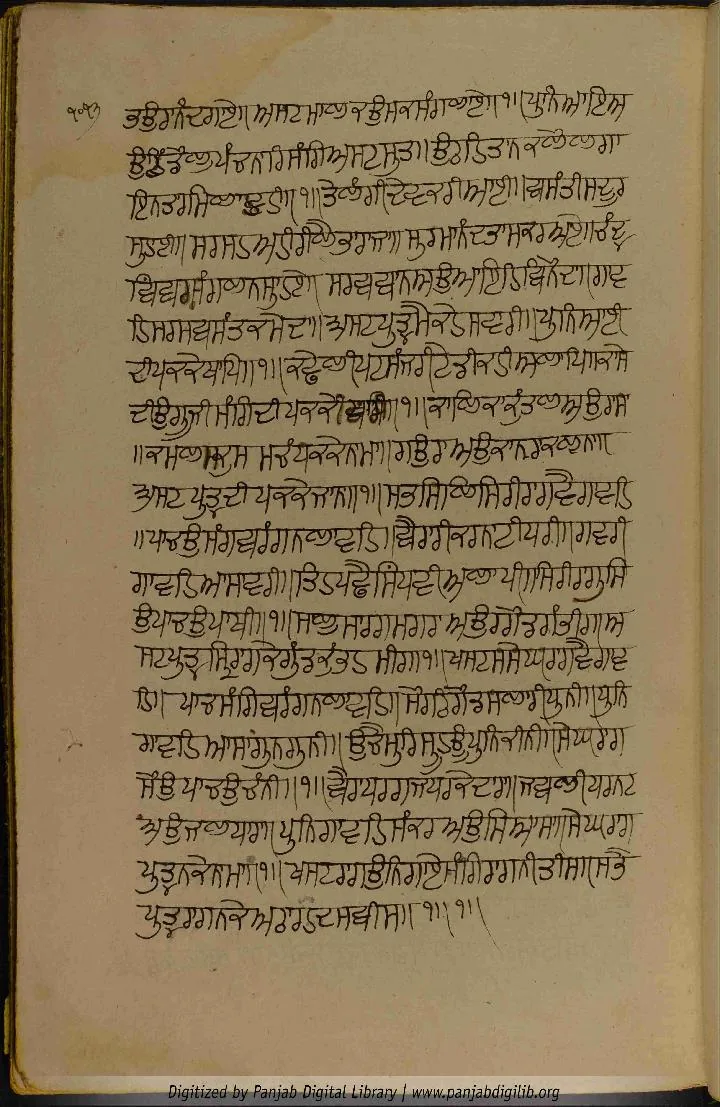
This argument accompanies the manuscript case elsewhere in the book. If Raagmala is already present in the original Bir, and Alam belongs to the later literary environment Dr Balbir Singh reconstructs, the shared passage can be explained as movement from scripture into the romance.
The limits of a vivid literary argument
Dr Balbir Singh sometimes personifies his argument. In one passage, he imagines Alam acknowledging how he used material from elsewhere. The writing is forceful and memorable, but the imagined speech must be read as the author's rhetorical device.
Alam's general statement about using other people's material does not explicitly name Raagmala or Sri Guru Granth Sahib Ji. Dr Balbir Singh himself introduces the more specific interpretation as an assumption to be examined through the continuing enquiry.
Turning that passage into a literal confession by Alam would erase the work the later chapters are trying to do. The specific borrowing is the conclusion supported by the combined argument, rather than a fact secured by an independently recorded admission.
The book also preserves a correction to Dr Balbir Singh's own reading of Jodh. After initially treating the verses incorrectly, he accepts that they are in the Anushtubh metre. He explains that examining the Sanskrit in Devanagari clarified what a faulty Gurmukhi presentation had obscured.
That correction belongs to the investigation's substance. It shows why examining a better witness can change a technical judgement and why the published enquiry should be read through to its later qualifications.
Where the investigation leads
Dr Balbir Singh's conclusion is clear: he identifies Alam as a later adapter who incorporated Raagmala from Sri Guru Granth Sahib Ji. The path to that conclusion passes through the distinction between source and translation, the interpretation of dates, shared literary material, the context of court poetry and the fit of the passage inside the romance.
Readers can understand his case most accurately by keeping each kind of evidence in view. A parallel line establishes a relationship to investigate. A chronology helps determine the possible direction of borrowing. A narrative irregularity can suggest insertion. A manuscript observation addresses the history of the scriptural entry.
The enquiry's value lies in bringing those questions together without collapsing them into one. It asks the reader to follow the history of a passage through the actual texts, while remembering that the loudest or most frequently repeated account still has to answer to the evidence.
Source: Dr Balbir Singh, Ragmala Da Swal, supplied 2006 edition, especially printed pp. 24-56, 84-88, 107-117 and 123-180. Printed page numbers are six lower than the corresponding PDF page numbers. The other literary works mentioned are discussed through this book only; no external sources or additional historical claims have been introduced.